


High Rate Battery vs High Capacity Battery: Which One Is Right for UPS Systems?
Which is the better choice for UPS systems, a high rate battery or a High Capacity Battery?
Choosing a ups battery is not simply a matter of selecting the battery with the highest Ah rating. The right battery depends on the power required by the UPS, how long the battery needs to support the load, and how the battery performs under the required discharge conditions.
High Rate Batteries and High Capacity Batteries are often discussed together, but they serve different purposes. High Rate Batteries are designed to deliver substantial power over relatively short discharge periods, while High Capacity Battery configurations are generally selected when longer backup time is required.
For UPS manufacturers, system integrators, distributors, data center operators, and industrial project procurement teams, understanding this distinction can help achieve more accurate battery selection and avoid unnecessary battery capacity.
What Is a High Rate Battery?
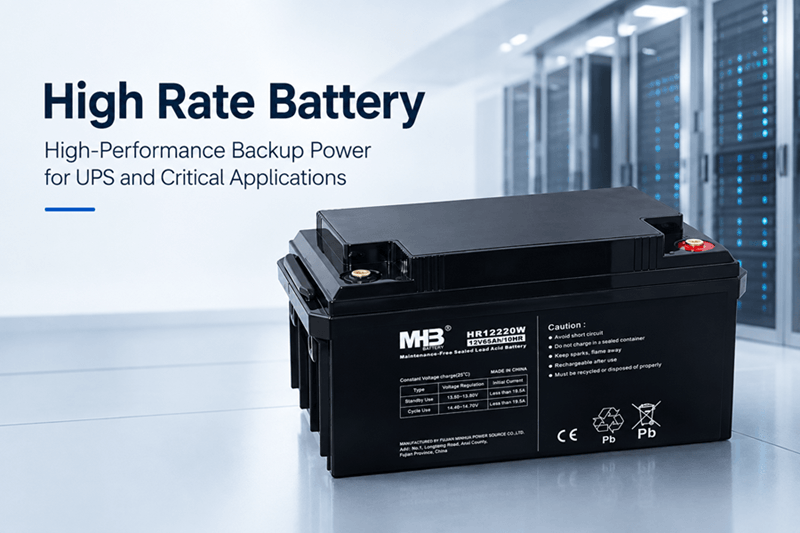
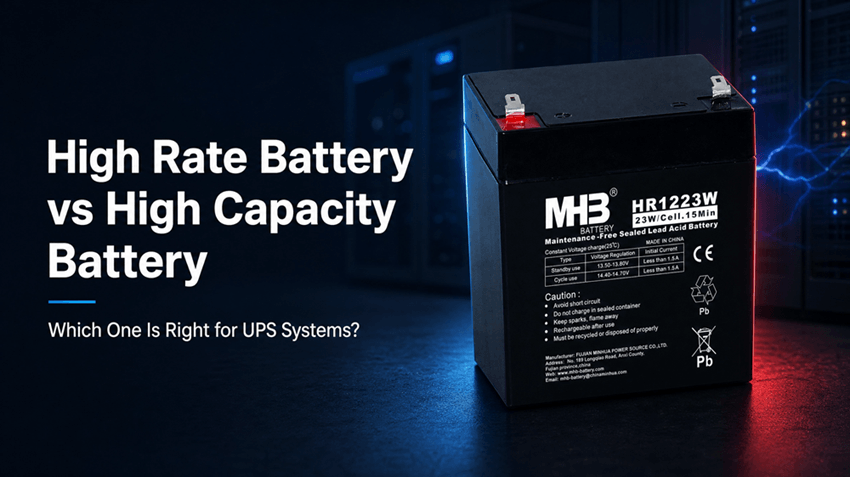
A High Rate Battery is designed to deliver high power over relatively short discharge periods.
High Rate Batteries are widely used in UPS systems because the battery may need to provide a high level of power immediately after utility power is interrupted. Their design places greater emphasis on high-current discharge performance, voltage stability, and power delivery.
Many High Rate Batteries used in UPS applications are based on VRLA technology. Their design is suited to applications where the battery needs to support a high load without requiring a long discharge period.
Typical applications include:
- UPS systems
- Data centers
- Telecommunications
- Industrial control systems
- Emergency backup power
- Critical power infrastructure
- Security and monitoring systems
High Rate Batteries are particularly relevant when the required backup time is relatively short but the connected load is high.
What Is a High Capacity Battery?
A High Capacity Battery is primarily selected to store more energy and provide a longer backup time.
Battery capacity is usually expressed in ampere-hours (Ah). However, the usable capacity of a battery is influenced by the discharge rate, operating temperature, end-of-discharge voltage, battery design, and other operating conditions.
For UPS applications requiring longer backup times, it may be necessary to use larger batteries, additional battery strings, or battery models designed for extended discharge.
High Capacity Battery configurations are commonly considered for applications such as:
- Extended UPS backup
- Industrial standby power
- Long-duration emergency power
- Remote power systems
- Telecom backup
- Systems with longer generator start-up or operating requirements
A higher Ah rating does not automatically make a battery the better choice. Battery capacity should always be matched to the actual load and required autonomy time.
High Rate Battery vs High Capacity Battery
The key difference lies in the primary requirement of the application.
High Rate Batteries are designed with greater emphasis on power delivery over shorter discharge periods, while High Capacity Batteries are primarily selected to provide sufficient stored energy for longer operation.
| Factor | High Rate Battery | High Capacity Battery |
|---|---|---|
| Primary focus | High power output | Longer backup duration |
| Typical discharge | Shorter duration | Longer duration |
| Main selection factor | Power and discharge performance | Capacity and runtime |
| Typical UPS use | Short-duration backup | Extended backup |
| High-current performance | Designed for high-rate discharge | Depends on battery design |
| Space requirement | Can provide high power within a compact configuration | May require a larger battery bank |
| Typical applications | UPS, data centers, critical power | Extended backup and long-duration applications |
| Selection basis | UPS load and discharge requirement | Load, runtime, and required capacity |
Battery performance varies according to the model and discharge conditions. Manufacturer discharge data should therefore be used when determining the final battery configuration.
Why Does UPS Battery Selection Depend on Discharge Time?
Discharge time is one of the key factors in UPS battery selection.
Different applications require different amounts of backup time. Some UPS systems may only need several minutes of battery support before utility power returns, a generator starts, or equipment completes a controlled shutdown. Other systems may require battery power for one or two hours.
Short-duration applications place greater emphasis on the battery's ability to deliver high power quickly. Longer-duration applications place more emphasis on usable capacity and sustained discharge performance.
A UPS therefore does not require the same battery configuration for a 10-minute backup period as it does for a two-hour backup period.
Even with the same UPS load, the required battery configuration can vary significantly depending on the required autonomy time.
Battery capacity also changes with discharge rate. The nominal Ah rating is normally specified under a particular discharge condition and should not be treated as a fixed value for every discharge profile.
This is why a battery with a higher Ah rating is not necessarily the better option for a high-power UPS.
Why Are High Rate Batteries Commonly Used in UPS Systems?
UPS systems may need to supply power immediately after an AC power interruption.
During this period, the battery provides DC power to the UPS inverter, allowing the inverter to continue supplying the connected equipment.
High Rate Batteries are designed for this type of demanding discharge profile.
Several characteristics are particularly important.
High Power Output
The battery must be able to provide sufficient power to meet the UPS load during the specified backup period.
Low Internal Resistance
Internal resistance contributes to voltage drop during high-current discharge. Lower internal resistance can help the battery maintain a more stable voltage as the load increases.
Short-Duration Discharge Performance
UPS systems often operate on battery power for a relatively short period before utility power returns, a generator starts, or equipment performs a controlled shutdown.
High Rate Battery designs are well suited to this type of operation.
Compact Power Delivery
High-power UPS installations may have limited space for batteries or battery cabinets. A battery configuration capable of delivering the required power within a compact footprint can simplify system design.
When Should You Select a High Rate Battery?
A High Rate Battery should be considered when a UPS application combines high power demand with a relatively short backup time.
Typical requirements include:
- High UPS load
- Short backup time
- High discharge current
- Critical power applications
- Data center UPS systems
- Limited battery installation space
- Generator-bridging applications
- Industrial UPS systems
A short backup requirement does not mean battery capacity can be ignored. The battery still needs to provide the required power at the specified end-of-discharge voltage.
Final selection should be based on the manufacturer's discharge tables rather than nominal capacity alone.
When Is a High Capacity Battery More Appropriate?
High Capacity Battery configurations become more relevant when the primary requirement is longer backup time.
Examples include applications where:
- The generator requires a longer start-up period
- Critical loads must operate throughout an extended outage
- Utility power interruptions may last for longer periods
- The UPS is designed for extended autonomy
- Additional battery capacity is required to meet the project runtime
Longer backup periods generally require more stored energy. Depending on the system design, this may involve larger batteries, additional battery strings, or a different battery series.
The required configuration should be based on the actual load and required runtime rather than the UPS rated power alone.
High Rate Battery vs High Capacity Battery for Data Centers
Data centers have demanding backup power requirements because UPS systems need to support servers, networking equipment, storage systems, and other critical infrastructure during power interruptions.
The appropriate battery configuration depends on the data center's power architecture and required autonomy time.
A High Rate Battery may be suitable when the UPS needs to provide high power for a relatively short period, such as bridging the time until generators become available or supporting a controlled shutdown.
A higher-capacity configuration may be more appropriate when the project requires longer battery autonomy.
Other factors should also be evaluated:
- UPS load profile
- Required backup time
- Battery room or cabinet space
- Operating temperature
- Battery design life
- Maintenance requirements
- Number of battery strings
- Charging capability
- Discharge characteristics
- Project safety margin
AI computing facilities and high-density data centers can place particularly high power demands on UPS systems. Battery selection should therefore be based on the actual power profile and required autonomy rather than on a general Ah comparison.
How to Choose the Right Battery for a UPS
Battery selection should begin with the actual requirements of the UPS.
1. Determine the Actual Load
UPS rated power does not always represent the actual operating load.
The battery system should be sized according to the load that needs to remain supported during a power outage.
2. Define the Required Backup Time
Backup time has a direct impact on battery configuration.
A system requiring several minutes of backup can have very different battery requirements from a system requiring one or two hours.
3. Check the DC System Voltage
The UPS battery bank must match the required DC voltage.
The number of cells or battery blocks connected in series depends on the UPS DC bus voltage and the battery voltage specification.
4. Check the Discharge Requirement
Discharge performance is one of the most important factors in battery selection.
For high-power UPS applications, the battery must be capable of delivering the required power over the specified discharge time and down to the specified end-of-discharge voltage.
Manufacturer discharge tables should be used to confirm whether the selected battery can meet the required load.
5. Consider Operating Temperature
Operating temperature has a direct effect on lead-acid battery performance and service life.
Battery sizing should take the actual installation environment into account, particularly for data centers, telecom facilities, and industrial sites.
Temperature conditions should be considered together with the manufacturer's specified operating range and temperature compensation requirements.
6. Review Installation Space
Battery dimensions and configuration can affect cabinet design, battery room layout, maintenance access, and installation costs.
The selected battery should provide the required performance while fitting the available installation space.
7. Check Charging Requirements
The selected battery should be compatible with the UPS charging voltage and charging current.
Charging characteristics should also be considered when determining the number of battery strings and the overall battery configuration.
8. Use Manufacturer Discharge Data
The final battery model should be selected using manufacturer-provided discharge data for the required load, discharge time, and end-of-discharge voltage.
Nominal Ah capacity alone is not sufficient for accurate UPS battery sizing.